
Before you read: if you haven’t visited Networkr GTA mode yet, go explore first. Meet the studio, poke around Eyefind and come back when you want to know how it all began.
Explore Networkr GTA mode ↗This was supposed to be one image.
We were putting together a post to introduce Networkr’s new website. The idea was simple: imagine our digital studio as a business operating somewhere in Grand Theft Auto. One promotional image, one joke, done.
Then curiosity got in the way. We started looking back at the fictional websites from earlier games: ridiculous businesses, news pages, search engines and advertisements that gave the world a second layer of satire.
That was when we ran into something unexpected. Rockstar had decided that GTA VI no longer needed traditional in-game websites. Suddenly, making just one image didn’t feel like enough.
What if, instead of showing what Networkr might look like in GTA, we actually built a little corner of the internet that the new game had left behind?
The question Rockstar asked first
In GTA IV and GTA V, the internet was part of the scenery. You could waste time reading made-up news, visit wildly questionable businesses or browse Eyefind, the series’ fictional search engine. You didn’t need those pages to finish every mission. They made the place feel like it had a life of its own.
In a Kotaku interview by Zack Zwiezen, published November 18, 2026, Rockstar’s Rob Nelson explained why the team focused on phone apps and social media instead. He recalled asking UI lead Stu Petri about websites and getting a wonderfully practical answer: “For what? What do you need it for?”
That is a perfectly understandable design decision. A world built around phones, apps and direct interactions reflects how digital services work today. We just liked the other possibility: imagining how GTA’s strange little internet might have survived and evolved.
Consider this a friendly tribute to a feature we loved, not a complaint about the people who made the game.
Eyefind was the first to come back
Of all those websites, Eyefind was the one that stuck with us most. It also felt like the one with the best chance of surviving into the present. Maybe not as a traditional search engine, but as a home for news, services, advertising, entertainment and apps.
So we started with Eyefind. Then we researched what was in GTA VI and found plenty of apps, including a dating app that felt strikingly familiar to anyone who has used Tinder. That gave the idea its next push: instead of treating websites and apps as rivals, our version of Eyefind could become a gateway to them.
An ecosystem began to take shape, populated by our own businesses, characters and increasingly dubious services. We weren’t trying to copy each screen. We wanted to write original jokes in the same absurd, irreverent spirit.
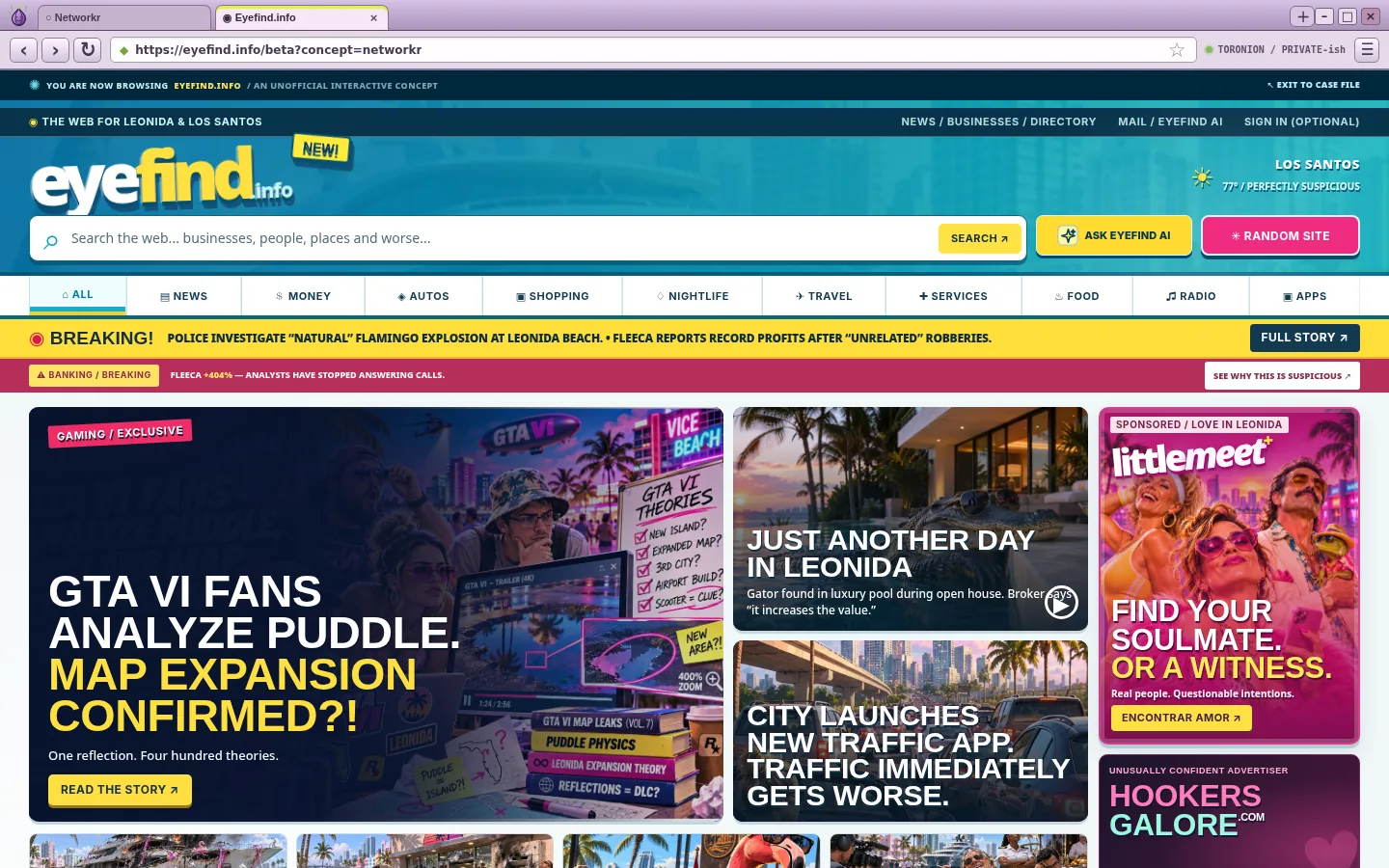
One page led to another
Early experiments leaned into comic-book graphics, neon and exaggerated advertising. Then came new compositions, a more cinematic version of Networkr in Leonida and an unavoidable question: if all these buttons and links were on the page, what happened when someone clicked them?
An ad needed a business. A business needed a website. One website pointed to another. Before long, we had questionable financial services, dating apps with original characters, transportation, satirical news and a collection of business cheat codes—the classic GTA cheat-code idea repurposed as terrible corporate advice.
We also built TorOnion, a fictional browser that lets visitors explore those worlds without leaving the experience. It wasn’t part of the master plan. It was a response to a problem we had created ourselves.
And yes, we built gloriously stupid transactions, including a bill that appears ready to be paid until Networkr steps in and makes the final amount $0.00. The joke works because the interface takes a ridiculous situation completely seriously.

A little roughness was the point
The in-game websites we remembered never had quite the same level of visual definition as the games around them. Their layouts could be odd, their ads excessive and their interfaces unlikely to win a minimalist design award. But those imperfections were part of their charm.
We chose to make the entire experience English-language, too. Not as a marketing strategy or a push for a bigger audience, but as part of the world-building. We wanted our fictional Networkr to feel at home alongside GTA’s businesses, ads, characters and interfaces. Language was one more way to make that little world feel believable.
We didn’t want to polish everything into a collection of interchangeable corporate apps. Some of the awkwardness is intentional: the goal was to preserve the spirit of those pages, not trace every pixel or scrub away their quirks.
That goes for the writing, too. The characters, businesses and many of the jokes are ours. The humor takes its cues from GTA’s satirical tone without copying its punchlines.
The joke still has to work
Just because a story is absurd doesn’t mean its controls should be. Buttons need to respond. Windows need to close. Text needs to be readable, especially on a phone. That is why the project went through so many iterations: every funny new idea created a very real design or navigation problem.
One of the latest additions is a fictional privacy center. Eyefind now talks about transparency in a way that sounds suspiciously profitable for Eyefind. The joke isn’t just a banner; it lives in how that imaginary company interprets a visitor’s choices.
There is a boundary worth keeping clear: the terrible privacy practices belong to the fiction. Real controls for local data and the actual behavior of the site must stay understandable, even when Eyefind’s fictional corporate voice would rather they didn’t.
Then there is Ask Eyefind AI, a fictional assistant whose attitude shifts over time. This first version runs on programmed JavaScript responses, contextual rules and local storage—not a generative API. We built it to play with personality and conversation design, not to claim we had invented the next frontier in AI.
The project we never planned to build
Networkr GTA mode grew in layers: an image, some research, a landing page, a search portal and eventually a small, navigable internet. We used AI tools to help generate and test alternatives, but the real work was choosing what belonged, what needed improving and what deserved to be cut.
We do not have Rockstar’s budget to build an entire city—and that might be for the best. Every version reminds us how easily this universe could expand forever. Knowing when to stop is a creative decision, too.
The interesting part isn’t the number of applications or lines of code. It’s following a curiosity far enough to end up somewhere we never expected.
Back outside Leonida
Networkr is a Chilean digital design and development studio. Our day-to-day work is building and maintaining websites, online stores, booking systems and digital platforms for real organizations. Out here, the jokes cannot get in the way of a purchase, an appointment or a business-critical service.
This experiment gave us room to play with identities, stories, behavior and the way people explore a website. It also exercised exactly the judgment serious work requires: think before building, test the results and keep refining beyond the first version.
We wanted to see what would happen if Networkr existed in Leonida.
Turns out there would be plenty of work. And very few clients willing to pay up front.